


Respiratory Chain
Energy Production
The respiratory chain is a series of protein complexes that transfer electrons to produce ATP in mitochondria.
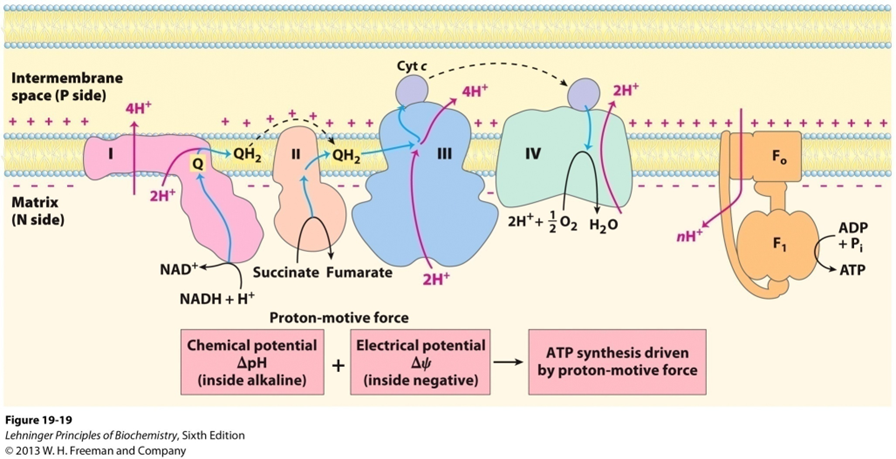
It is a key component of oxidative phosphorylation, the process by which cells generate ATP, the primary energy currency of the cell. The respiratory chain consists of four large enzyme complexes (Complexes I-IV), as well as mobile electron carriers like ubiquinone (Coenzyme Q) and cytochrome c, that work together to transfer electrons from high-energy molecules (such as NADH and FADH2) to molecular oxygen.
The process begins when NADH and FADH2, generated from glycolysis, the citric acid cycle, and fatty acid oxidation, donate electrons to Complex I (NADH dehydrogenase) and Complex II (succinate dehydrogenase), respectively. These complexes then transfer the electrons to ubiquinone (Coenzyme Q), a lipid-soluble molecule that shuttles electrons to Complex III (cytochrome bc1 complex). Electrons are then passed from Complex III to cytochrome c, a small heme-containing protein, which carries them to Complex IV (cytochrome c oxidase).
In Complex IV, electrons are finally transferred to molecular oxygen (O2), the terminal electron acceptor, which combines with protons (H+) to form water (H2O). This final step ensures that the chain can continue operating, as oxygen is required to prevent electron buildup.
As electrons move through the chain, protons (H+) are pumped across the inner mitochondrial membrane from the mitochondrial matrix to the intermembrane space, creating an electrochemical gradient known as the proton motive force (PMF). This gradient represents stored energy that is used by ATP synthase (Complex V), a large enzyme complex that allows protons to flow back into the matrix. The energy from this proton flow drives the phosphorylation of ADP to ATP.
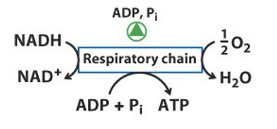
The respiratory chain is tightly regulated by several mechanisms to ensure efficient ATP production and maintain cellular homeostasis. Oxygen availability is one of the primary factors regulating the respiratory chain. When oxygen levels are low, as in hypoxia, the electron transport chain becomes less efficient, and cells rely more on anaerobic pathways like glycolysis for ATP production.
The activity of the respiratory chain is also influenced by the ATP/ADP ratio. High levels of ATP indicate that the cell has sufficient energy, leading to a reduction in the activity of the chain. Conversely, when ATP levels are low and ADP levels are high, the activity of the chain is upregulated to produce more ATP.
Additionally, the availability of NADH and FADH2 from metabolic processes like the citric acid cycle and fatty acid oxidation can influence the flow of electrons through the chain. The efficient functioning of the respiratory chain depends on the proper interaction and balance between all the complexes, as well as the presence of adequate oxygen, substrates, and electron carriers.
Thus, the respiratory chain is not only critical for ATP production but also for maintaining cellular energy homeostasis. Through its regulation, the cell can optimize energy production, respond to changes in oxygen and nutrient availability, and maintain efficient metabolic function.