


Glycogen Synthase
Carbohydrate Metabolism
Glycogen synthase catalyzes the addition of glucose units to growing glycogen chains during glycogenesis.
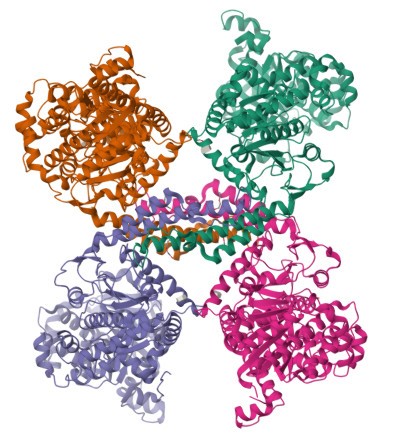
Glycogen synthase catalyzes the addition of glucose units to growing glycogen chains during glycogenesis, the process by which glycogen is synthesized from glucose. This enzyme plays a central role in energy storage, particularly in liver and muscle cells, where glycogen acts as a reserve fuel source. Glycogen synthase transfers glucose from UDP-glucose (uridine diphosphate glucose) to the non-reducing ends of glycogen molecules, elongating the glycogen chains by forming alpha-1,4-glycosidic bonds.
Glycogen synthesis is initiated when glucose-6-phosphate, derived from glucose metabolism, is converted to glucose-1-phosphate, which then reacts with UTP (uridine triphosphate) to form UDP-glucose, the direct precursor of glycogen. Glycogen synthase then adds UDP-glucose to the growing glycogen polymer. However, the process is regulated to ensure that glycogen is only synthesized when energy is abundant and the body has enough glucose to store.
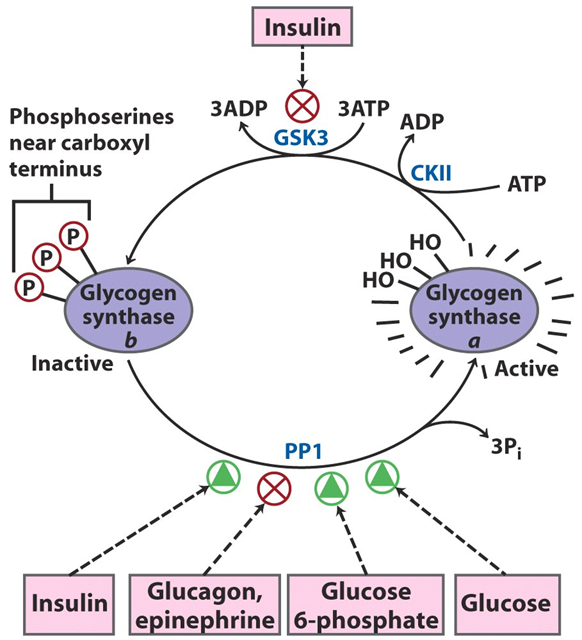
Glycogen synthase activity is tightly regulated by covalent modification and allosteric regulation to match the body’s energy status. The enzyme exists in two forms: the active “a” form and the inactive “b” form, with activity being primarily regulated through phosphorylation. The inactive form is phosphorylated by several kinases, including glycogen synthase kinase-3 (GSK-3), AMP-activated protein kinase (AMPK), and protein kinase A (PKA), which are activated by signaling molecules such as glucagon and epinephrine during periods of low blood glucose or stress. When phosphorylated, glycogen synthase is inhibited, reducing glycogen synthesis.
Conversely, glycogen synthase is activated by insulin, which promotes the dephosphorylation of the enzyme through the activation of protein phosphatases. Insulin, released in response to high blood glucose levels, signals that energy stores should be built up by promoting glycogen synthesis. Additionally, glucose-6-phosphate acts as an allosteric activator, enhancing the enzyme’s activity when glucose is abundant and indicating that glycogen synthesis should proceed.
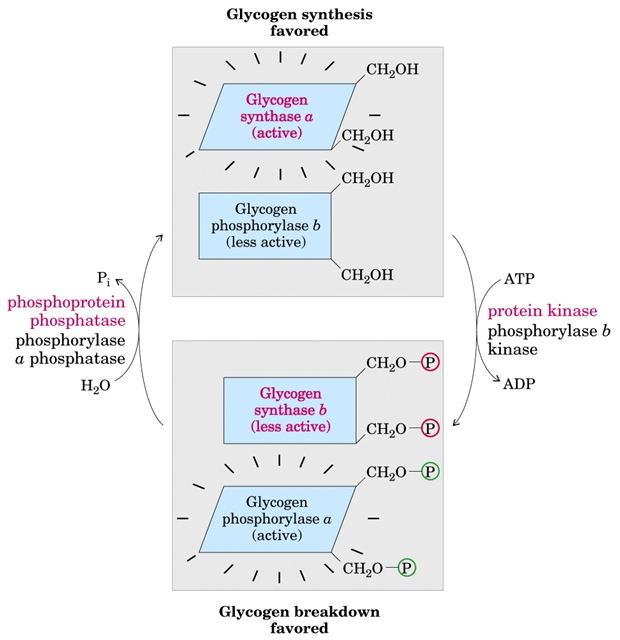
Thus, the regulation of glycogen synthase ensures that glycogen is synthesized when glucose is plentiful and energy needs are met, while being inhibited when energy is required elsewhere or glucose levels are low. This delicate balance helps maintain metabolic homeostasis and supports efficient energy storage and release.