


Pyruvate
Carbonhydrate Metabolites
Pyruvate is a key metabolic intermediate in glycolysis, linking glucose metabolism to the citric acid cycle.
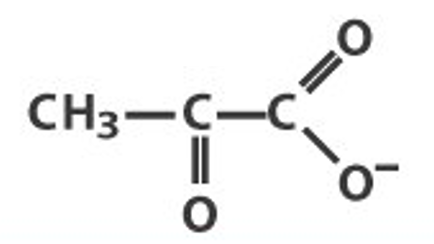
It is the end product of glycolysis, the anaerobic breakdown of glucose, where one molecule of glucose is converted into two molecules of pyruvate, generating ATP in the process. Pyruvate plays a pivotal role in linking carbohydrate metabolism with aerobic energy production in the mitochondria.
Under aerobic conditions, pyruvate is transported into the mitochondria, where it is decarboxylated by the enzyme pyruvate dehydrogenase to form acetyl-CoA, a key substrate for the citric acid cycle (Krebs cycle). Acetyl-CoA then enters the citric acid cycle, generating high-energy molecules like NADH and FADH2, which are used in the electron transport chain to produce ATP through oxidative phosphorylation. This process is central to energy production in most eukaryotic cells.
In the absence of oxygen or under anaerobic conditions, pyruvate undergoes fermentation. In muscle cells, this leads to the production of lactic acid (lactate), while in yeast cells, pyruvate is converted to ethanol and carbon dioxide. The conversion of pyruvate to lactate regenerates NAD+, allowing glycolysis to continue producing small amounts of ATP when oxygen is not available for oxidative phosphorylation.
Beyond its role in energy production, pyruvate also acts as a precursor for various biosynthetic pathways. It can be converted to alanine through transamination, contributing to amino acid metabolism. Pyruvate can also be used for the synthesis of glucose in gluconeogenesis, primarily in the liver, where it is converted back to glucose to maintain blood sugar levels during fasting or prolonged exercise.
In addition, pyruvate is involved in the regulation of key enzymes and metabolic pathways. It plays a role in the regulation of insulin secretion and the activation of AMP-activated protein kinase (AMPK), which helps maintain cellular energy balance.
Overall, pyruvate serves as a critical intersection in metabolic pathways, integrating carbohydrate, amino acid, and fatty acid metabolism to support cellular energy needs, biosynthesis, and homeostasis.